Beacons and pigeons

A replica of one of Chappe’s semaphore towers
Homing pigeons have occasionally been used throughout history by different cultures. Pigeon post had Persian roots, and was later used by the Romans to aid their military. Frontinus said that Julius Caesar used pigeons as messengers in his conquest of Gaul. The Greeks also conveyed the names of the victors at the Olympic Games to various cities using homing pigeons. In the early 19th century, the Dutch government used the system in Java and Sumatra. And in 1849, Paul Julius Reuter started a pigeon service to fly stock prices between Aachen and Brussels, a service that operated for a year until the gap in the telegraph link was closed.
In the Middle Ages, chains of beacons were commonly used on hilltops as a means of relaying a signal. Beacon chains suffered the drawback that they could only pass a single bit of information, so the meaning of the message such as “the enemy has been sighted” had to be agreed upon in advance. One notable instance of their use was during the Spanish Armada, when a beacon chain relayed a signal from Plymouth to London.
In 1792, Claude Chappe, a French engineer, built the first fixed visual telegraphy system (or semaphore line) between Lille and Paris. However semaphore suffered from the need for skilled operators and expensive towers at intervals of ten to thirty kilometres (six to nineteen miles). As a result of competition from the electrical telegraph, the last commercial line was abandoned in 1880.
Telegraph and telephone
On 25 July 1837 the first commercial electrical telegraph was demonstrated by English inventor Sir William Fothergill Cooke, and English scientist Sir Charles Wheatstone. Both inventors viewed their device as “an improvement to the [existing] electromagnetic telegraph” not as a new device.
Samuel Morse independently developed a version of the electrical telegraph that he unsuccessfully demonstrated on 2 September 1837. His code was an important advance over Wheatstone’s signaling method. The first transatlantic telegraph cable was successfully completed on 27 July 1866, allowing transatlantic telecommunication for the first time.
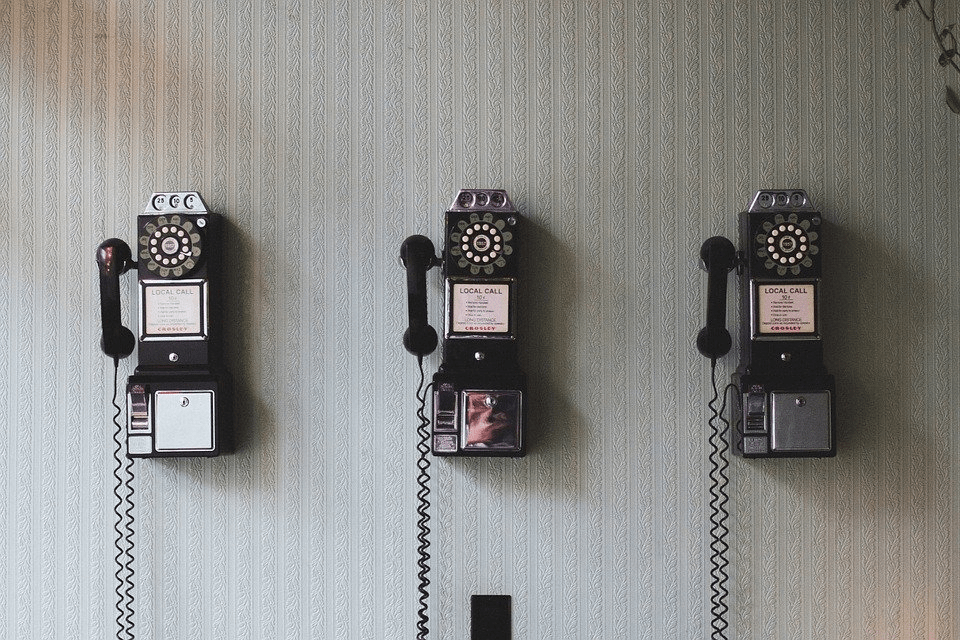
The conventional telephone was patented by Alexander Bell in 1876. Elisha Gray also filed a caveat for it in 1876. Gray abandoned his caveat and because he did not contest Bell’s priority, the examiner approved Bell’s patent on March 3, 1876. Gray had filed his caveat for the variable resistance telephone, but Bell was the first to write down the idea and the first to test it in a telephone. Antonio Meucci invented a device that allowed the electrical transmission of voice over a line nearly thirty years before in 1849, but his device was of little practical value because it relied on the electrophonic effect requiring users to place the receiver in their mouths to “hear”. The first commercial telephone services were set-up by the Bell Telephone Company in 1878 and 1879 on both sides of the Atlantic in the cities of New Haven and London.
Radio and television
Starting in 1894, Italian inventor Guglielmo Marconi began developing a wireless communication using the then newly discovered phenomenon of radio waves, showing by 1901 that they could be transmitted across the Atlantic Ocean. This was the start of wireless telegraphy by radio. Voice and music were demonstrated in 1900 and 1906, but had little early success.
Millimetre wave communication was first investigated by Bengali physicist Jagadish Chandra Bose during 1894–1896, when he reached an extremely high frequency of up to 60 GHz in his experiments. He also introduced the use of semiconductor junctions to detect radio waves, when he patented the radio crystal detector in 1901.
World War I accelerated the development of radio for military communications. After the war, commercial radio AM broadcasting began in the 1920s and became an important mass medium for entertainment and news. World War II again accelerated development of radio for the wartime purposes of aircraft and land communication, radio navigation and radar. Development of stereo FM broadcasting of radio took place from the 1930s on-wards in the United States and displaced AM as the dominant commercial standard by the 1960s, and by the 1970s in the United Kingdom.
Semiconductor era
The modern period of telecommunication history from 1950 onwards is referred to as the semiconductor era, due to the wide adoption of semiconductor devices in telecommunication technology. The development of transistor technology and the semiconductor industry enabled significant advances in telecommunication technology, and led to a transition away from state-owned narrowband circuit-switched networks to private broadband packet-switched networks. There was a rapid growth of the telecommunications industry towards the end of the 20th century, driven by the development of metal-oxide-semiconductor (MOS) large-scale integration (LSI) technology, information theory, digital signal processing, and wireless communications such as cellular networks and mobile telephony.
Transistors
The development of transistor technology has been fundamental to modern electronic telecommunication. The first transistor, a point-contact transistor, was invented by John Bardeen and Walter Houser Brattain at Bell Labs in 1947. The MOSFET (metal-oxide-silicon field-effect transistor), also known as the MOS transistor, was later invented by Mohamed Atalla and Dawon Kahng at Bell Labs in 1959. The MOSFET is the building block or “workhorse” of the information revolution and the information age, and the most widely manufactured device in history. MOS technology, including MOS integrated circuits and power MOSFETs, drives the communications infrastructure of modern telecommunication. Along with computers, other essential elements of modern telecommunication that are built from MOSFETs include mobile devices, transceivers, base station modules, routers, RF power amplifiers, microprocessors, memory chips, and telecommunication circuits.
Computer networks and the Internet
On 11 September 1940, George Stibitz transmitted problems for his Complex Number Calculator in New York using a teletype, and received the computed results back at Dartmouth College in New Hampshire. This configuration of a centralized computer (mainframe) with remote dumb terminals remained popular well into the 1970s. However, already in the 1960s, researchers started to investigate packet switching, a technology that sends a message in portions to its destination asynchronously without passing it through a centralized mainframe. A four-node network emerged on 5 December 1969, constituting the beginnings of the ARPANET, which by 1981 had grown to 213 nodes. ARPANET eventually merged with other networks to form the Internet. While Internet development was a focus of the Internet Engineering Task Force (IETF) who published a series of Request for Comment documents, other networking advancements occurred in industrial laboratories, such as the local area network (LAN) developments of Ethernet (1983) and the token ring protocol (1984).
Wireless telecommunication
The wireless revolution began in the 1990s, with the advent of digital wireless networks leading to a social revolution, and a paradigm shift from wired to wireless technology, including the proliferation of commercial wireless technologies such as cell phones, mobile telephony, pagers, wireless computer networks, cellular networks, the wireless Internet, and laptop and handheld computers with wireless connections. The wireless revolution has been driven by advances in radio frequency (RF) and microwave engineering, and the transition from analog to digital RF technology Advances in metal-oxide-semiconductor field-effect transistor (MOSFET, or MOS transistor) technology, the key component of the RF technology that enables digital wireless networks, has been central to this revolution.
Digital media
Practical digital media distribution and streaming was made possible by advances in data compression, due to the impractically high memory, storage and bandwidth requirements of uncompressed media. The most important compression technique is the discrete cosine transform (DCT), a lossy compression algorithm that was first proposed as an image compression technique in 1972. Realization and demonstration, on 29 October 2001, of the first digital cinema transmission by satellite in Europe of a feature film by Bernard Pauchon, Alain Lorentz, Raymond Melwig and Philippe Binant.
 Tech Geeks